
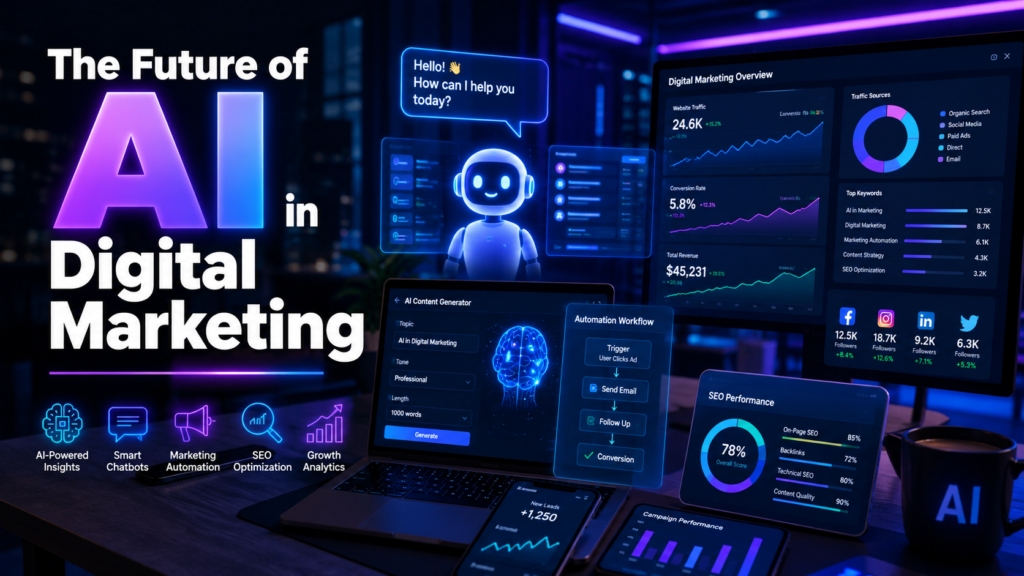
Artificial Intelligence (AI) is no longer a futuristic concept—it has become one of the most powerful forces driving innovation in digital marketing. From personalized customer experiences and predictive analytics to automated content creation and advanced SEO strategies, AI is revolutionizing how businesses connect with their audiences.
As we move further into 2026 and beyond, marketers who embrace AI technologies will gain a significant competitive advantage. Companies that fail to adapt risk falling behind in an increasingly data-driven and customer-centric digital landscape.
In this article, we’ll explore the future of AI in digital marketing, the benefits it offers, emerging trends, challenges, and how businesses can prepare for the next wave of marketing transformation.
If you’re new to online marketing, be sure to read our complete guide:
What Is Digital Marketing? A Beginner’s Guide
to understand the fundamentals before exploring AI-powered strategies.
What Is AI in Digital Marketing?
AI in digital marketing refers to the use of artificial intelligence technologies, machine learning algorithms, and automation tools to analyze data, predict customer behavior, optimize campaigns, and improve marketing performance.
Modern AI systems can process enormous amounts of data in real time, helping marketers make smarter decisions faster than ever before.
Some common applications include:
- Content generation
- SEO optimization
- Email marketing automation
- Chatbots and customer support
- Predictive analytics
- Personalized recommendations
- Social media management
- Advertising optimization
Why AI Is Becoming Essential for Digital Marketing
Consumer expectations continue to rise. Customers expect personalized experiences, instant responses, and highly relevant content.
AI helps businesses meet these expectations by:
1. Improving Personalization
AI analyzes user behavior, browsing history, and purchasing patterns to deliver personalized experiences.
Examples include:
- Product recommendations
- Personalized emails
- Dynamic website content
- Customized advertising campaigns
This level of personalization increases engagement and conversion rates.
2. Enhancing Marketing Efficiency
Many repetitive marketing tasks can now be automated.
AI tools can:
- Schedule social media posts
- Segment audiences
- Optimize ad bids
- Generate reports
- Create marketing content
As a result, marketers spend less time on manual work and more time on strategy.
3. Delivering Better Data Insights
AI-powered analytics tools can identify patterns that humans may overlook.
Marketers can use these insights to:
- Predict customer behavior
- Identify emerging trends
- Improve targeting
- Reduce campaign waste
Major AI Trends Shaping the Future of Digital Marketing
AI-Powered Content Creation
Content remains a cornerstone of digital marketing, but AI is changing how content is produced.
Modern AI writing tools can help create:
- Blog posts
- Product descriptions
- Social media captions
- Email campaigns
- Video scripts
While human creativity remains important, AI significantly accelerates the content creation process.
Predictive Marketing
Predictive analytics uses historical data and machine learning to forecast future customer actions.
Businesses can predict:
- Purchase intent
- Customer churn
- Product demand
- Best times to launch campaigns
This allows marketers to make proactive decisions instead of reactive ones.
Voice Search Optimization
Voice assistants continue to grow in popularity.
As more users search through voice commands, marketers must optimize content for conversational search queries.
Future SEO strategies will increasingly focus on:
- Natural language keywords
- Question-based content
- Featured snippets
- Local search optimization
To better understand modern search optimization techniques, check out our article: SEO Explained Simply for Beginners.
Hyper-Personalization
Traditional personalization is evolving into hyper-personalization.
AI can now deliver individualized experiences based on real-time behavior and contextual data.
Examples include:
- Personalized website experiences
- Dynamic product recommendations
- Customized landing pages
- Real-time content adjustments
AI-Powered Chatbots and Virtual Assistants
Customer service is becoming more intelligent through AI.
Advanced chatbots can:
- Answer customer questions instantly
- Recommend products
- Collect leads
- Provide 24/7 support
This improves customer satisfaction while reducing operational costs.
The Impact of AI on SEO
Search engine optimization is undergoing significant transformation due to AI.
Search engines are becoming smarter and better at understanding user intent.
Future SEO success will depend on:
User Intent Optimization
Rather than focusing solely on keywords, marketers must create content that genuinely satisfies user needs.
Content Quality
AI-powered search algorithms increasingly reward:
- Helpful content
- Expertise
- Trustworthiness
- User experience
Semantic Search
Search engines now understand relationships between topics and concepts.
Content creators should focus on comprehensive topic coverage instead of keyword stuffing.
Benefits of AI in Digital Marketing
The future benefits of AI include:
Increased ROI
AI improves targeting accuracy, reducing wasted marketing spend.
Faster Decision-Making
Real-time data analysis enables quicker responses to market changes.
Better Customer Experiences
Personalized interactions create stronger customer relationships.
Improved Productivity
Automation allows teams to accomplish more with fewer resources.
Enhanced Competitive Advantage
Businesses adopting AI early can outperform competitors that rely on traditional methods.
Challenges Marketers Must Address
Despite its advantages, AI presents several challenges.
Data Privacy Concerns
Businesses must comply with privacy regulations and use customer data responsibly.
Dependence on Technology
Over-reliance on automation can reduce human creativity and strategic thinking.
Skill Gaps
Marketing professionals need continuous education to stay updated with AI advancements.
Ethical Considerations
Transparency and responsible AI usage will become increasingly important.
How Businesses Can Prepare for the AI-Driven Future
Organizations should begin preparing now by:
- Investing in AI marketing tools
- Training marketing teams
- Building strong data strategies
- Prioritizing customer privacy
- Combining AI with human creativity
- Monitoring emerging trends
The most successful companies will be those that balance automation with authentic human connections.
Conclusion
The future of AI in digital marketing is incredibly promising. Artificial intelligence is transforming every aspect of marketing—from content creation and SEO to customer service and predictive analytics.
As technology continues to evolve, marketers who embrace AI-driven strategies will be better positioned to deliver personalized experiences, improve campaign performance, and drive sustainable business growth.
Rather than replacing marketers, AI is becoming a powerful partner that enhances creativity, efficiency, and decision-making.
The businesses that adapt today will lead the digital marketing landscape tomorrow.
According to
Google Search Central Documentation ,
creating helpful, people-first content remains one of the most important ranking factors.