
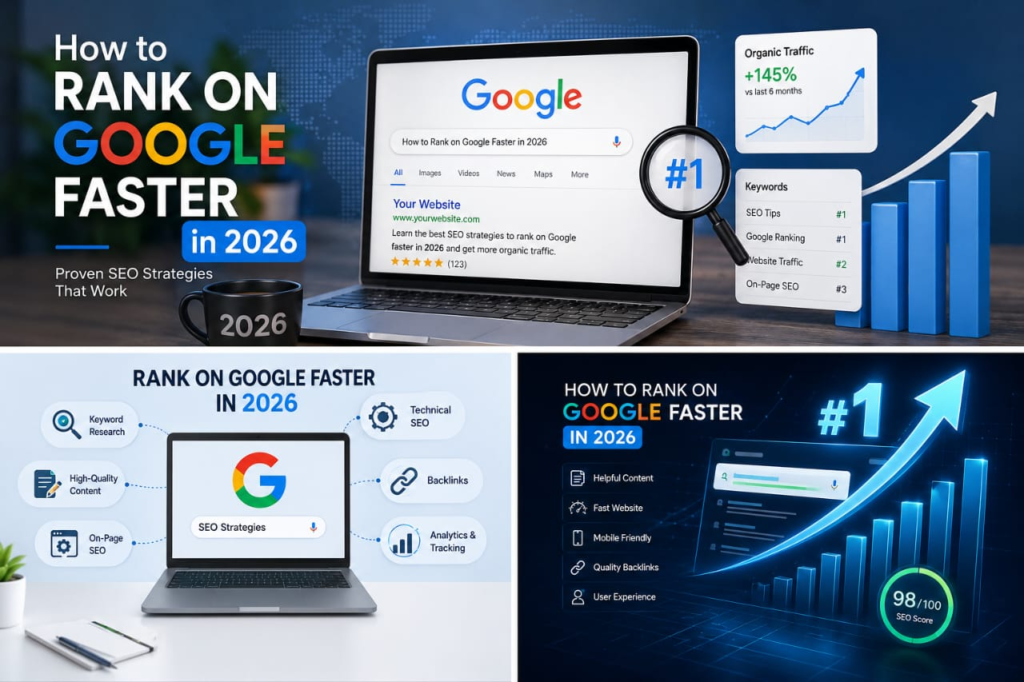
If you have a website, blog, or online business, one of your biggest goals is probably to appear on the first page of Google. Higher rankings mean more visitors, greater brand visibility, and more opportunities to generate leads or sales. The good news is that ranking on Google is possible for both new and established websites when you follow the right SEO strategies.
In 2026, Google continues to prioritize helpful, trustworthy, and user-focused content. This means that simply adding keywords is no longer enough. To rank faster, you need high-quality content, excellent user experience, fast website performance, and a strong SEO foundation.
In this guide, you’ll learn the most effective strategies to rank on Google faster in 2026, whether you’re a beginner, blogger, small business owner, or digital marketer.
Table of Contents
- Why Google Rankings Matter
- How Google Ranks Websites in 2026
- Choose the Right Keywords
- Create High-Quality Content
- Optimize On-Page SEO
- Improve Website Speed
- Make Your Website Mobile-Friendly
- Build High-Quality Backlinks
- Use Internal Linking
- Track Your SEO Performance
- Common SEO Mistakes
- Frequently Asked Questions
- Final Thoughts
Why Google Rankings Matter
Google processes billions of searches every day. Most users click one of the first few results, making top rankings extremely valuable.
Ranking higher on Google can help you:
- Increase organic traffic without paying for ads.
- Build trust and authority in your industry.
- Generate more leads and customers.
- Improve brand awareness.
- Achieve long-term business growth.
Unlike paid advertising, SEO continues to bring visitors long after your content is published.
How Google Ranks Websites in 2026
Google uses hundreds of ranking signals to determine which pages deserve the top positions in search results. While the exact algorithm is constantly evolving, several factors remain essential.
These include:
- Helpful and original content
- Search intent satisfaction
- Page loading speed
- Mobile-friendly design
- Secure HTTPS connection
- Quality backlinks
- Strong internal linking
- Positive user experience
- Topical authority
The websites that consistently publish valuable content and provide a great user experience usually perform better over time.
Choose the Right Keywords
Keyword research is the foundation of every successful SEO strategy.
Before writing any article, identify what your audience is searching for. Focus on keywords that have good search volume but manageable competition.
For example, instead of targeting a broad keyword like:
SEO
You could target a more specific keyword such as:
How to Rank on Google Faster in 2026
This long-tail keyword is more focused and matches what users are actually searching for.
You should also include related keywords naturally throughout your article, such as:
- Google SEO
- Website ranking
- Organic traffic
- Search engine optimization
- On-page SEO
- Technical SEO
- Google ranking factors
Using relevant keywords naturally helps Google better understand your content without keyword stuffing.
Create High-Quality Content
Content remains the most important part of SEO.
Every article should answer the user’s questions clearly and provide practical, actionable advice.
To create content that ranks well:
- Write comprehensive guides.
- Use simple language.
- Include examples where possible.
- Break content into short paragraphs.
- Add bullet points for readability.
- Update older articles regularly.
Google rewards content that demonstrates expertise, experience, authority, and trustworthiness (E-E-A-T).
As you build your website, you can also guide readers to related resources such as What Is Digital Marketing? A Beginner’s Guide, SEO Explained Simply for Beginners, and Top 10 Benefits of Digital Marketing for Small Businesses. These internal links help users discover more content while strengthening your site’s SEO.
Optimize Your On-Page SEO
On-page SEO refers to optimizing the elements on your web pages so search engines can better understand your content. Even the best article may struggle to rank if its on-page SEO is poor.
Here are the most important on-page SEO practices for 2026.
Write an Engaging Title Tag
Your title tag is one of the first things users see in Google Search. It should include your primary keyword and encourage people to click.
Example:
How to Rank on Google Faster in 2026: 12 Proven SEO Strategies
Create a Compelling Meta Description
A well-written meta description improves your click-through rate (CTR). Keep it between 150 and 160 characters and include your target keyword naturally.
Use Proper Heading Structure
Organize your content using headings.
- H1 for the page title
- H2 for major sections
- H3 for supporting topics
This structure makes your content easier to read for both users and search engines.
Optimize Images
Images improve user experience, but they should also be optimized.
Best practices include:
- Compress images to improve loading speed.
- Use descriptive file names.
- Add keyword-rich alt text.
- Choose modern image formats such as WebP when possible.
Improve URL Structure
Keep URLs short, descriptive, and easy to read.
Good example:
yourwebsite.com/how-to-rank-on-google-faster-in-2026
Avoid unnecessary numbers or random characters.
Improve Website Speed
Page speed has become one of the most important ranking factors.
Visitors expect websites to load quickly. If your pages take too long, users may leave before reading your content.
To improve website speed:
- Compress images before uploading.
- Remove unnecessary plugins.
- Enable browser caching.
- Minify CSS and JavaScript files.
- Choose reliable web hosting.
- Use a Content Delivery Network (CDN).
A faster website provides a better user experience and can improve your search rankings.
Make Your Website Mobile-Friendly
Most Google searches now come from mobile devices.
Your website should automatically adjust to different screen sizes while remaining easy to navigate.
A mobile-friendly website should have:
- Responsive design
- Readable text
- Fast loading speed
- Easy navigation
- Clickable buttons
- Proper spacing
Google primarily uses the mobile version of your website for indexing and ranking.
Build High-Quality Backlinks
Backlinks remain one of Google’s strongest ranking signals.
A backlink is a link from another website pointing to your content. However, quality is much more important than quantity.
Ways to earn quality backlinks include:
- Publishing original research
- Writing in-depth guides
- Guest posting on reputable websites
- Creating shareable infographics
- Building useful free tools
- Producing helpful tutorials
Avoid buying backlinks or participating in link schemes, as these practices can harm your rankings.

Use Internal Linking
Internal links connect related pages on your own website.
They help visitors discover more content while allowing search engines to crawl your website more efficiently.
For example, you can naturally link to:
- What Is Digital Marketing? A Beginner’s Guide
- SEO Explained Simply for Beginners
- How Social Media Marketing Helps Businesses Grow
- Email Marketing vs Social Media Marketing: Which Is Better?
- Top 10 Benefits of Digital Marketing for Small Businesses
A strong internal linking strategy also helps distribute page authority across your website.
Track Your SEO Performance
SEO is an ongoing process. After publishing your content, monitor its performance regularly.
Useful metrics include:
- Organic traffic
- Keyword rankings
- Click-through rate (CTR)
- Bounce rate
- Average engagement time
- Conversion rate
Use trusted tools such as Google Search Console and Google Analytics to understand how your content performs and identify opportunities for improvement.
For official SEO guidance, refer to Google’s Search Central documentation, which provides best practices directly from Google.
Common SEO Mistakes to Avoid
Many websites fail to rank because they make simple but costly SEO mistakes. Avoiding these issues can help your content perform better in Google Search.
1. Keyword Stuffing
Repeating the same keyword too many times makes your content difficult to read and may hurt your rankings. Instead, use your primary keyword naturally and include related terms where appropriate.
2. Publishing Thin Content
Short articles that provide little value rarely perform well. Aim to create comprehensive, helpful content that fully answers the reader’s questions.
3. Ignoring Search Intent
Always understand what users are looking for before creating content. If someone searches for “How to Rank on Google Faster in 2026,” they expect practical strategies—not just a definition of SEO.
4. Not Updating Old Content
SEO is not a one-time task. Review your articles regularly, update outdated information, add new examples, and improve sections that are no longer relevant.
5. Poor User Experience
Slow-loading pages, intrusive pop-ups, broken links, and difficult navigation can drive visitors away. A positive user experience encourages people to stay longer and explore more of your website.
Frequently Asked Questions (FAQ)
How long does it take to rank on Google?
The time varies depending on your competition, website authority, and content quality. Some pages may rank within a few weeks, while competitive keywords can take several months.
Can a new website rank on Google?
Yes. New websites can rank by targeting low-competition keywords, publishing helpful content consistently, and following SEO best practices.
Are backlinks still important in 2026?
Yes. High-quality backlinks continue to be one of Google’s strongest ranking signals. Focus on earning links naturally from trusted and relevant websites.
Does AI-generated content rank on Google?
Google evaluates content based on its quality and usefulness, not simply how it was created. Content that is accurate, original, and genuinely helpful has a better chance of ranking well.
What is the most important SEO factor?
There is no single ranking factor. Successful SEO combines helpful content, keyword optimization, technical SEO, backlinks, website speed, mobile usability, and a great user experience.
Final Thoughts
Ranking on Google faster in 2026 requires a long-term strategy built on quality, consistency, and user value. Focus on understanding your audience, creating content that solves real problems, optimizing every page for search engines, and continuously improving your website.
Remember that SEO is a marathon, not a sprint. The websites that consistently publish valuable content, maintain a fast and user-friendly experience, and build authority over time are the ones most likely to achieve sustainable rankings.
Whether you’re running a personal blog, a small business website, or an eCommerce store, applying the strategies in this guide can help you increase your visibility, attract more organic traffic, and grow your online presence.
Call to Action
Ready to improve your Google rankings? Start by optimizing one page today. Conduct keyword research, publish high-quality content, strengthen your internal linking strategy, and monitor your performance regularly. Small, consistent improvements can lead to significant long-term SEO success.
If you found this guide helpful, be sure to explore our other SEO and digital marketing resources, including:
- What Is Digital Marketing? A Beginner’s Guide
- SEO Explained Simply for Beginners
- Top 10 Benefits of Digital Marketing for Small Businesses
- How Social Media Marketing Helps Businesses Grow
- Email Marketing vs Social Media Marketing: Which Is Better?
By combining these resources with the strategies you’ve learned here, you’ll be well on your way to achieving better Google rankings in 2026 and beyond.