
Introduction
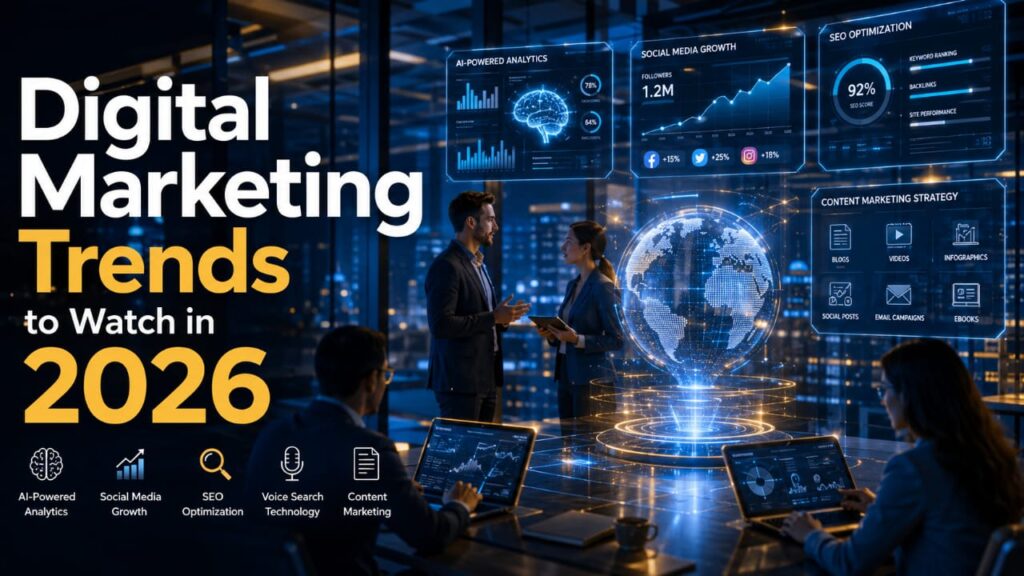
Digital marketing continues to evolve at a rapid pace, driven by technological advancements and changing consumer behaviours. Businesses that want to remain competitive must stay informed about emerging trends and adapt their strategies accordingly. As we move through 2026, several innovations are reshaping how brands connect with their audiences, generate leads, and drive sales.
From artificial intelligence and hyper-personalization to voice search optimization and social commerce, the digital marketing landscape is becoming more sophisticated than ever. Understanding these trends can help businesses create more effective marketing campaigns, improve customer experiences, and achieve sustainable growth.
In this article, we explore the most important digital marketing trends to watch in 2026 and how businesses can leverage them for success.
Artificial Intelligence Will Dominate Marketing
Artificial intelligence (AI) is no longer a futuristic concept—it has become an essential tool for modern marketers. In 2026, AI continues to transform digital marketing by improving efficiency, personalization, and decision-making.
AI-powered tools can analyze large amounts of customer data, identify patterns, and predict future behaviors. Marketers can use these insights to create targeted campaigns that resonate with specific audiences.
Some key applications of AI in digital marketing include:
- Automated content creation
- Predictive analytics
- Customer segmentation
- Personalized recommendations
- AI-powered chatbots
- Marketing automation
Businesses that embrace AI can save time, reduce costs, and deliver more relevant experiences to customers.
Hyper-Personalization Is Becoming Essential
Today’s consumers expect personalized experiences. Generic marketing messages are becoming less effective as customers demand content tailored to their needs and preferences.
Hyper-personalization uses data, AI, and automation to deliver highly relevant content to individual users. This approach helps businesses build stronger relationships with customers and improve conversion rates.
Examples of hyper-personalization include:
- Personalized email campaigns
- Product recommendations
- Dynamic website content
- Customized advertisements
- Location-based promotions
Brands that invest in personalization can significantly increase customer engagement and loyalty.
Voice Search Optimization Will Continue to Grow
The popularity of smart speakers and voice assistants has increased dramatically over the past few years. Consumers are increasingly using voice commands to search for information, shop online, and interact with businesses.
As a result, voice search optimization is becoming an important component of SEO strategies.
Businesses should focus on:
- Using natural language keywords
- Optimizing for conversational searches
- Creating FAQ content
- Improving local SEO
- Enhancing website speed
Voice searches are often longer and more conversational than traditional searches, making it important to adapt content accordingly.
Video Marketing Remains a Powerful Tool
Video content continues to dominate digital marketing in 2026. Consumers prefer watching videos because they are engaging, informative, and easy to consume.
Short-form videos have become particularly popular on social media platforms, allowing brands to capture attention quickly and effectively.
Benefits of video marketing include:
- Higher engagement rates
- Better brand awareness
- Increased website traffic
- Improved conversion rates
- Stronger customer trust
Businesses should incorporate educational videos, product demonstrations, customer testimonials, and behind-the-scenes content into their marketing strategies.
Social Commerce Is Expanding Rapidly
Social media platforms are evolving into powerful shopping destinations. Consumers can now discover products, read reviews, and complete purchases without leaving their favorite social platforms.
Social commerce offers several advantages for businesses looking to grow online:
- Streamlined purchasing process
- Enhanced customer experience
- Increased brand visibility
- Higher conversion opportunities
Brands that effectively combine social media marketing with e-commerce can generate significant revenue and reach broader audiences.
Privacy-First Marketing Is the New Standard
As consumers become more concerned about online privacy, businesses must adopt transparent and ethical data collection practices.
The decline of third-party cookies has encouraged marketers to focus on first-party data strategies. Companies are increasingly collecting information directly from customers through:
- Website registrations
- Email subscriptions
- Surveys
- Loyalty programs
- Customer feedback forms
Privacy-focused marketing helps build trust and ensures compliance with evolving regulations.
Marketing Automation and Chatbots
Marketing automation continues to play a crucial role in improving efficiency and customer engagement.
Automated systems can handle repetitive tasks such as:
- Email marketing
- Lead nurturing
- Customer follow-ups
- Social media scheduling
- Audience segmentation
Meanwhile, AI-powered chatbots provide instant customer support, answer common questions, and assist users throughout the buying journey.
Automation allows businesses to scale their marketing efforts while maintaining consistent communication with customers.
Influencer Marketing Is Becoming More Authentic
Influencer marketing remains an effective strategy, but audiences are increasingly seeking authenticity.
Rather than focusing solely on celebrities, many brands are partnering with micro-influencers who have highly engaged communities and strong credibility within specific niches.
Benefits of working with micro-influencers include:
- Higher engagement rates
- Greater trust among followers
- More targeted audiences
- Cost-effective campaigns
Authentic partnerships often generate better results than large-scale promotional campaigns.
The Future of SEO in 2026
Search engine optimization continues to evolve as search engines become more sophisticated.
Modern SEO focuses on providing valuable content that satisfies user intent rather than simply targeting keywords.
Key SEO trends include:
Search Intent Optimization
Understanding what users are looking for helps businesses create content that answers questions and solves problems.
User Experience Signals
Website speed, mobile responsiveness, and user engagement are increasingly important ranking factors.
High-Quality Content
Search engines reward content that demonstrates expertise, authority, and trustworthiness.
AI-Powered Search
Businesses must optimize content for AI-driven search experiences and emerging search technologies.
A strong SEO strategy remains one of the most effective ways to generate long-term organic traffic.
Data Analytics and Predictive Marketing
Data-driven decision-making is becoming more important than ever.
Advanced analytics tools help businesses understand customer behavior, measure campaign performance, and identify growth opportunities.
Predictive marketing uses historical data and AI algorithms to forecast future customer actions, allowing marketers to make proactive decisions.
This approach helps businesses:
- Improve targeting
- Increase ROI
- Reduce marketing waste
- Enhance customer experiences
Organizations that leverage data effectively gain a significant competitive advantage.
How Businesses Can Prepare for These Trends
To remain competitive in 2026, businesses should take the following steps:
- Invest in AI-powered marketing tools.
- Prioritize customer personalization.
- Optimize content for voice search.
- Create engaging video content.
- Build a strong social commerce strategy.
- Focus on privacy and data transparency.
- Automate repetitive marketing tasks.
- Strengthen SEO efforts.
- Use analytics to guide decisions.
- Continuously monitor emerging technologies.
By proactively adapting to industry changes, businesses can position themselves for long-term success.
Conclusion
Digital marketing in 2026 is defined by innovation, personalization, and technology-driven strategies. Artificial intelligence, voice search, social commerce, video marketing, privacy-first practices, and advanced SEO techniques are reshaping the way businesses connect with customers.
Companies that embrace these trends will be better equipped to improve customer experiences, increase brand visibility, and drive sustainable growth. The digital landscape will continue to evolve, but businesses that remain flexible and forward-thinking can turn these changes into valuable opportunities.
The future of digital marketing is exciting, and now is the perfect time to prepare for what lies ahead.